
Looking back on 4 years of Anki
After 4 years of dailyish study, I recently hit 10,000 cards in my Japanese flashcard deck!
 The lucky 10,000th Anki card was 偏重 “attaching too much importance to”. I was hoping it would be a more fun and vivid word than that, but oh well. #9,996 was the much more colorful idiom 蜘蛛の子を散らす “to scatter in all directions (like baby spiders)” and I briefly considered lying that that’s my 10,000th card to make this a funnier post, but I simply have too much integrity to deceive you all like that.
I’d been studying Japanese on and off since the year 2000, pretty seriously at first. I did a college year abroad in Japan and passed the level 2 proficiency test. Then after getting a full-time job, I basically stopped entirely circa 2009-2021, and by the end of that fallow period, I probably only remembered like a thousand words and 100 kanji. Then for a variety of good reasons (certainly not because of a midlife crisis!) I got serious about derusting/relearning it in early 2022.
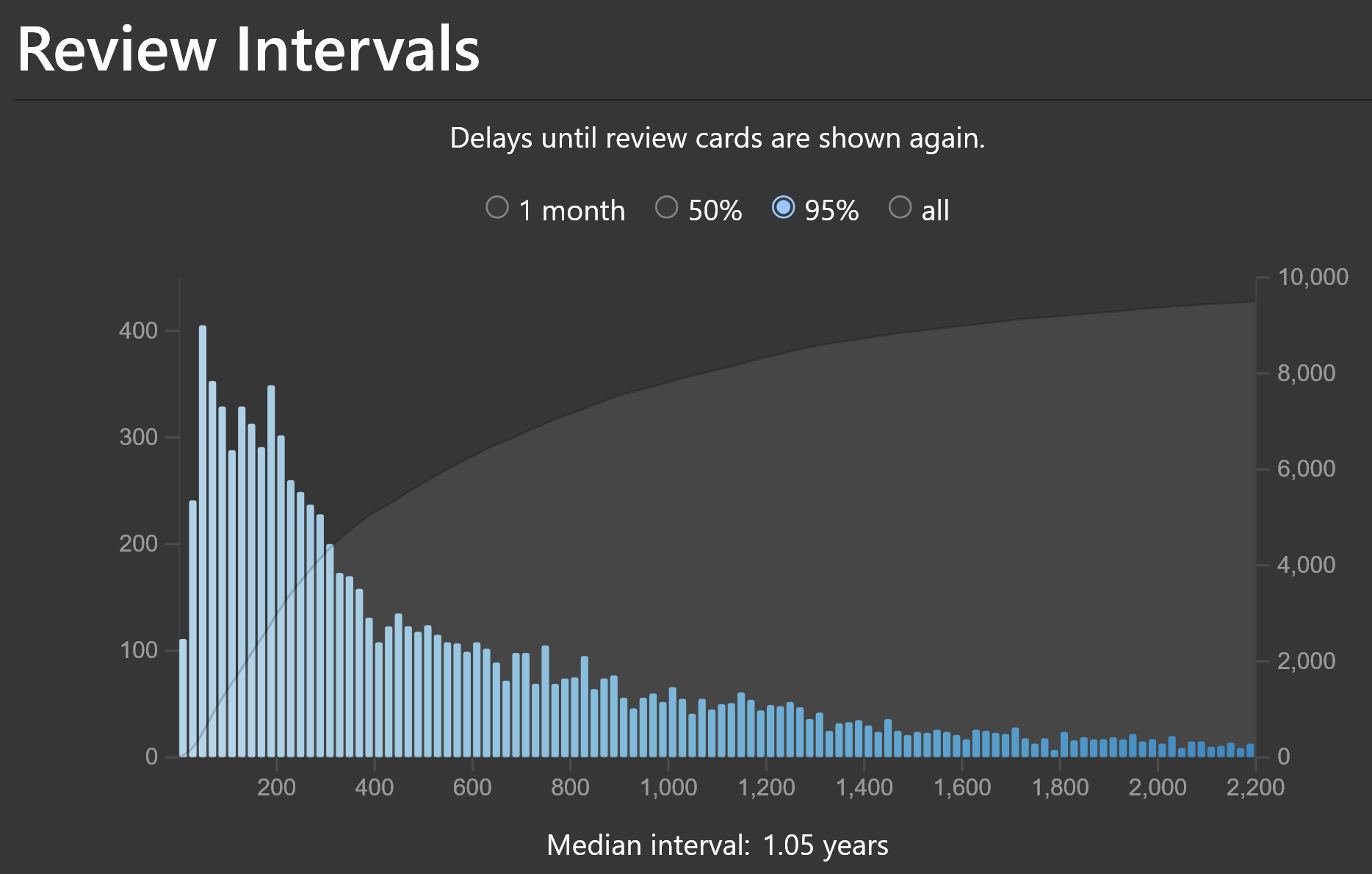
So I googled what do serious autodidacts use to learn Japanese nowadays, and that’s when I learned Anki exists, and apparently had since 2006 actually. I had used physical flashcards before, but they’re only really useful for short-term cramming. Whereas Anki popularized a scheme where the more you’ve demonstrated to it that you know a word, the less frequently it shows you the flashcard for it. Meaning the method scales up to gigantic decks that you can study at a leisurely pace for years (like mine now):
 My derusting journey started off with a premade N3 deck, and there are a couple hundred premade grammar cards in there too. But 90% of the cards come from personal “mining”, i.e. when I encounter a new word in a novel/blogpost/game/anime, I look it up with Yomitan (a dictionary tool). And then if I feel like memorizing it, I click a button to add the word and its definition to my Anki deck.
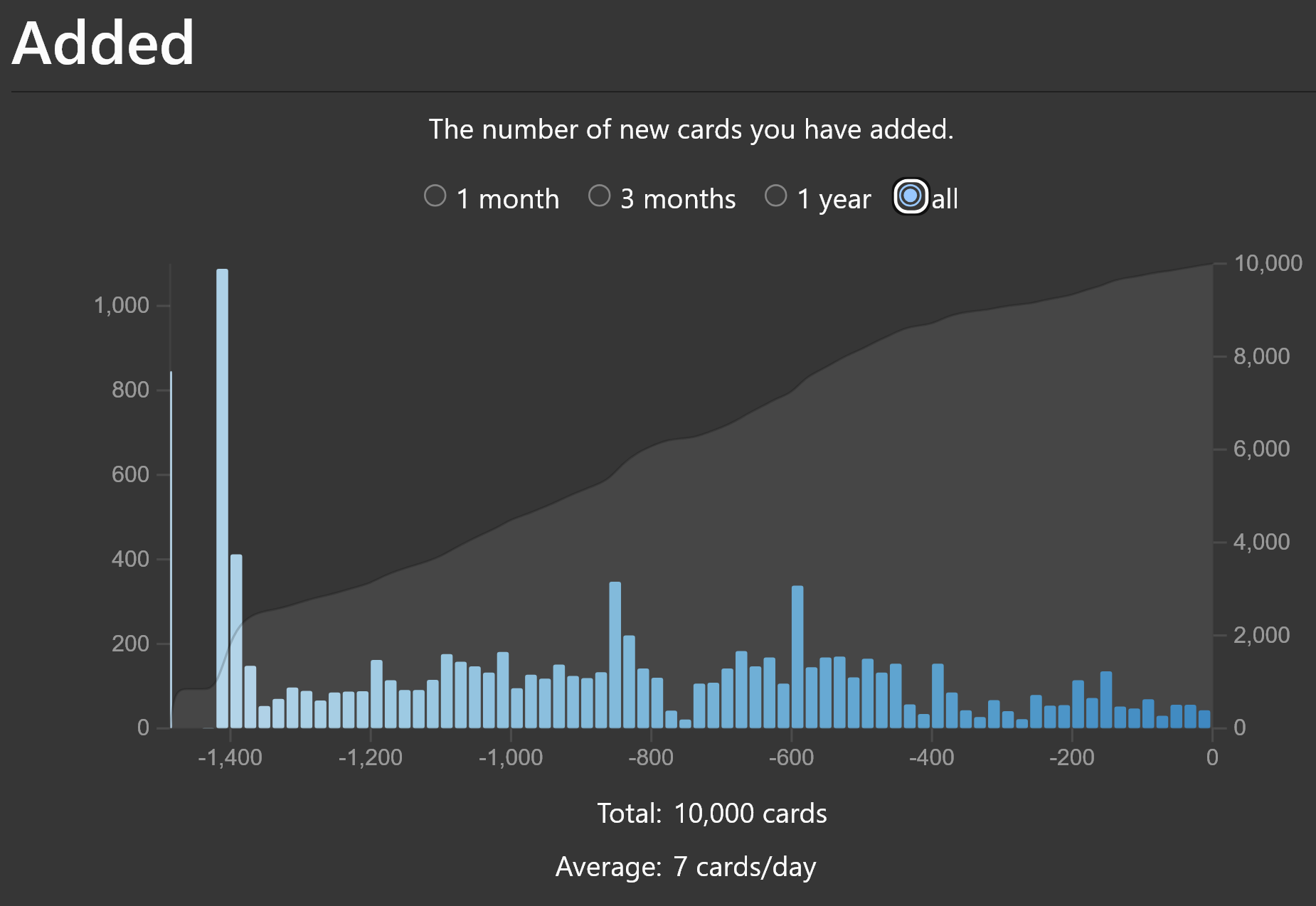
Looks like I’ve averaged 7 new cards a day and ~100 reviews a day since I started. But that average conceals a lot of bursty irregularities. There have been days when I spent most of the day reading a difficult novel and added 100+ words, whereas most days I add 0-2.
I’ve been a bit surprised with myself that my motivation to study flashcards hasn’t flagged that much even after I met my main goals for Japanese skill level. Reviewing them on my smartphone pretty quickly got deeply embedded in my habits as a way to kill time that’s more productive-feeling (and also more meditative) than all the other ways to kill time with a smartphone. For example, while waiting in line at the post office, while lying in bed with my eyes wide open at 4am, or while waiting for my dog to finish his dinner (the anxiety-prone beast won’t keep eating if I don’t quietly stand next to him the whole time).
And because I started learning Japanese before Anki even existed, I’m acutely aware that my memory is a sieve, and that simply doing a lot of reading and looking up words in the dictionary doesn’t really work that well for me on its own. The spaced repetition practice has been night and day in terms of how consistently I’m able to get better. To me, 20-30 minutes of daily review feels like a quite small time investment that averts a great deal of forgetting. And when I’m reading and see a fun or useful-looking new word, it still feels almost like magic that I can click a “do not forget this” button that works ~90% of the time.