
Eisen Flügel's opening exposition
I noticed the light novel Eisen Flügel is one of the works by the dark-fantasy author Gen Urobuchi to remain untranslated, and a movie based on it is currently in development, so there may soon be more interest in an English translation of it.
To decide if it’s something I might want to work on, I tried translating the first couple of pages of Chapter 1. It’s quite an different style from what I’ve worked on before; it’s cerebral and controlled at the stylistic level, but an infectious enthusiasm comes through. Here is what I’ve got as a first draft:
Chapter 1: Wings of Iron
The glittering jade freshwater travels serenely downstream. Now and then, the tranquil surface is stirred up by a fierce whirlwind, provoking bubbles and pushing it back upstream.
The whirlwinds’ authors are the tails of Nebel Dragons. This smaller-sized subspecies is more typically seen playing among misty mountain peaks, but today they are flying so low and fast that the rippling water-surface reflects the color of their bellies. And there are three of them. They fly together in a perfect arrowhead formation, never deviating from it an inch.
Even the cruising flight speed of Nebel Dragons exceeds 300 knots. To grasp just how exceptional dragonflight is, consider that the top speed of a peregrine falcon swooping towards its prey is at most 200 knots.
Their source of propulsion is the fierce vibrations of their pleated tails. These produce a pocket of extremely high air pressure, which in turn interacts with the aerodynamic properties of their stiff wings to drive prodigious flight speeds. But in comparison to Glanz Dragons, whose propulsion mechanism is not even understood, Nebel Dragons are actually the more tractable benchmark for human flight.
Indeed, at this very moment a propeller plane is challenging them, its reciprocating engine roaring angrily as it’s drenched in the dust the three dragons are trailing behind them.
The experimental airplane “Puffin”: wingspan 35 feet, weight squeezed down to as low as 5000 pounds, a smallish race-spec body not weighed down by any military equipment. Combined with its 1750-horsepower, 12-cylinder, liquid-cooled engine, it is surely the swiftest civil aircraft currently in service. Above all, it can take pride in its twin propellers, rotating in opposite directions with offsetting pitch. These provide it with at once speed and stability, allowing the Puffin to be among the very few aircraft with performance in the same ballpark as dragons. Until now, its highest recorded speed has been 412 knots. Its full-throttle speed, now, is bit-by-bit closing the distance with the tails of the Nebel Dragons.
If we were to look at this as a chase scene, involving a hunter and a prey which he heatedly pursues, then surely the hunter is none other than the Puffin. However, within its teardrop-shaped canopy, on the rear of its two seats, its passenger is in the precise opposite state of mind.
“Stoooopppp!! Ittt!!! Slooooooowwww! Dooooownnn!!”
What I like about this opening is the deliberate way it introduces one key fantasy concept at a time and lingers on it, before segueing to the next. River -> dragons -> plane -> human characters. Urobuchi hides key elements of the scene from the reader before he’s ready to reveal them, briefly creating a tiny mystery around where he’s heading.
A pretty river didn’t feel like the most inspired first sentence for a fantasy novel at first. But I realized its function is less to be interesting in itself than to ground what follows on something familiar from real life. In the second sentence the first fantasy concept is introduced, these whirlwinds strong enough to make the river flow backwards. That’s a cool detail about the dragons that comes into view before the dragons themselves.
On a more technical note, the original Japanese uses gikun to make the dragon species names self-explanatory and have fantasy-world flavor at the same time. That is, they use familiar kanji, whose standard pronunciation is overridden by unfamiliar German sounds. The Nebel Dragons appear like this in the original text:
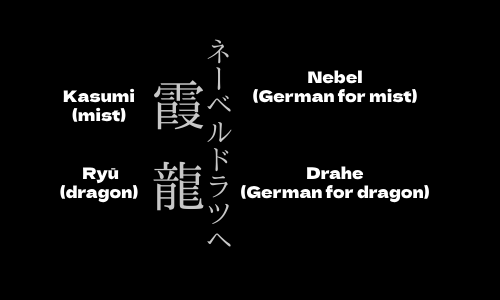
In my version, I compromised by keeping the German word for “mist” but switching “Drahe” to “dragon”.
Since English readers will probably not know that “Nebel” means “mist” either, I also tentatively introduced the adjective “misty” to the sentence that describes their usual habitat. However, a trick like this runs the risk of introducing a worldbuilding detail that wasn’t intended: maybe they are actually called that because their propulsion method tends to generate mist when they leave their rarefied habitat? This is the sort of word choice that I might go back and change in a later draft, if something later in the novel answers this question.