
Table of Contents
A founding work of Buddhpunk
I recently discovered sci-fi author Yashima Yūgen and his 2018 novella 天駆せよ法勝寺 (the author’s chosen English title is “Hosshōji the Rocket Temple”, and the Japanese title means roughly “Activate the Heaven Drive, Hosshōji!”). I was sold as soon as I saw the cover:
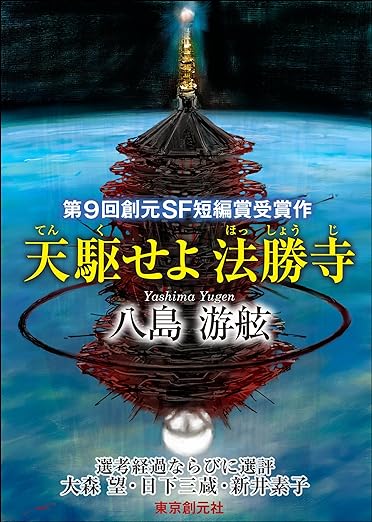
Hosshōji is the fourth of the great rocket temples to take flight, after Seishōji, Enshōji, and the other Enshōji. It is made out of hardwood compressed under ultra-high-pressure (far stronger than any metal). Its launch booster is a “prayer furnace” with a fuel capacity of 460 supplication-days, its warp drive is based on the principles of Buddhist reincarnation, and the reliquary sphere at the very top contains a tooth of the Gautama Buddha (to cut aerodynamically though the Buddha-nature of spacetime).
I am about a third of the way through reading it so far. I needed to look up words in Yomitan on average once per sentence in the first chapter, with all its obscure religious terminology and hybrid science-Buddhism neologisms. But it rewarded my struggle with many laugh-out-loud moments when I recognized how cleverly it punned with and remixed Buddhism.
I’m starting to read a lot faster now that the the setting has been established. In the third chapter, it seems to be developing a mystery about where exactly Hosshōji is going and why. Only the secretive head monk Ganshin has full knowledge of these basic facts, which remain under seal for the lower-ranking monks.
This novella has not yet been published in English, but the author Yashima Yūgen has excellent English and has published several English-language blogposts about it and his vision for a new genre called “Buddhpunk”:
For example, what do Buddhists think about technological developments such as nuclear power, the Internet, AI, and evolving modern values? Can AI and robots attain enlightenment? What will happen if a new buddha appears? How can one reconstruct the Buddhist cosmic structure, chuu (or bardo, the transitional stage between death and rebirth), and reincarnation in a science-fiction way?
[…]
I’m tired of stale worldviews such as cyberpunk and steampunk. If it is possible to build a civilization based on cyber infrastructure or steam engines, it should also be possible to build a civilization based on buddhics.